

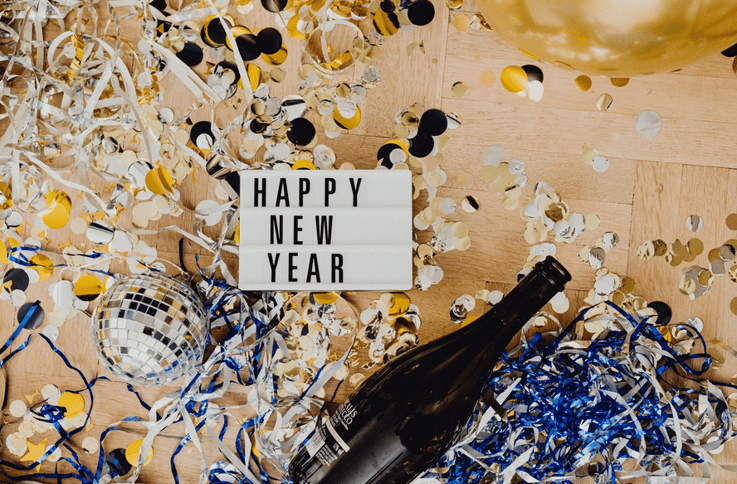
 The transition from one year to the next is perhaps the most universally celebrated holiday on Earth, yet the customs surrounding it are as diverse as they are ancient. For many, the routine is standard: a glass of champagne, a rendition of a song nobody quite knows the lyrics to, and a kiss at midnight. But have you ever stopped to wonder why we do these things?
Why We Celebrate on January 1st
It seems obvious now, but January 1st hasn't always been the starting line. In fact, for centuries, the new year was celebrated in late March. This made agricultural sense, as it coincided with the vernal equinox and the arrival of spring—a time of actual rebirth and new growth.
The shift happened thanks to Julius Caesar. When he reformed the calendar in 46 B.C., he established January 1st as the start of the year. This date honored Janus, the Roman god of beginnings (and endings). Janus is depicted with two faces: one looking backward into the past and one looking forward into the future. It was a fitting choice for a holiday centered on reflection and anticipation.
However, old habits die hard. Even after the Julian calendar was adopted, many regions in medieval Europe continued to celebrate the new year at different times, often tying it to religious festivals like Easter or Christmas. It wasn't until Pope Gregory XIII introduced the Gregorian calendar in 1582 that January 1st was solidified as the universal standard we use today.
The Times Square Ball Drop
If you turn on the television on New Year's Eve in the United States, you will almost certainly see the Times Square Ball. It is an iconic symbol, but dropping a ball to mark the passage of time wasn't invented for a party. It was originally a tool for sailors.
In the 19th century, "time balls" were installed in ports around the world. These balls would drop at a precise time (usually 1:00 p.m.) so that ship captains could synchronize their chronometers, which was essential for navigation at sea.
The tradition migrated to Times Square in 1907. The city had previously celebrated with fireworks, but after a ban on explosives, the event organizers needed a safer, flashy alternative. They took inspiration from the maritime devices and commissioned a 700-pound ball made of iron and wood. Today, the ball weighs nearly 12,000 pounds and is covered in Waterford Crystal, but the concept remains exactly the same as it was over a century ago.
Auld Lang Syne: The Song Nobody Knows
As soon as the clock strikes midnight, the melody of "Auld Lang Syne" begins to play. It is the most performed song on New Year's Eve, yet it remains a mystery to most who sing it.
The song is attributed to the Scottish poet Robert Burns, who transcribed it in 1788, though he claimed he was merely preserving an older folk song he had heard. The title roughly translates from Scots to "Times Gone By" or "For the Sake of Old Times."
Conceptually, the song is a call to remember old friendships and not let the past be forgotten as we move forward. It asks the rhetorical question: "Should old acquaintance be forgot?" The answer, the song suggests, is no. We should share a "cup of kindness" for the days gone by. It became associated with New Year's Eve thanks to a Canadian band leader named Guy Lombardo, who played it on his radio show at midnight every year starting in 1929.
Resolutions: A 4,000-Year-Old Habit
If you have ever made a resolution to go to the gym on January 1st only to quit by January 15th, you are participating in a tradition that dates back to ancient Babylon.
The Babylonians are the first recorded civilization to set New Year's resolutions, though theirs were more practical than ours. During their New Year festival, Akitu, they would make promises to the gods to return borrowed farm equipment and pay off their debts. They believed that keeping these promises would put them in the gods' favor for the coming year.
Today, nearly 40% of Americans make resolutions, usually focused on self-improvement or health. While statistics show that only about 9% of people successfully keep them all year, the act of making them serves a psychological purpose. It is what researchers call the "fresh start effect"—using a temporal landmark to reset our habits and behavior.